Investment

  • 5 Common Reasons Home Loan Applications Are Rejected

    Applying for a home loan is both exciting and stressful. When you are successful, there’s nothing like receiving that green light from a lender to say you’re on the home run to securing your dream home.

    But it’s important to be aware that even if you do have pre-approval, you can be knocked back for a home loan. Pre-approval is an indication from a lender that they’re likely to approve you for a specific loan, but you still have to meet certain lending conditions.

    Here are some of the common reasons why a mortgage application may be denied after you’ve been pre-approved, and what to do if you are rejected.

    Your financial situation has changed

    A change to your financial situation could impact your home loan application. Maybe you’ve lost your job or are working less since you were pre-approved.

    Lenders will look at your ability to comfortably repay a home loan, and if your income has taken a hit of late, then you may be rejected. Likewise, if you’ve changed jobs since getting pre-approved, your lender may deem you to be a risky borrower and decline your home loan application.

    Bottom line: avoid changing jobs or selling assets between pre-approval and applying for a mortgage.

    Your credit score has deteriorated

    If you’ve applied for other credit products since being pre-approved (such as a car loan or credit card), taken on more debt or missed repayments on existing debt, your credit score may be affected. This in turn could impact your ability to get over the line with a lender.

    Be mindful of managing your existing debt carefully and avoid applying for other forms of debt after pre-approval.

    The lending criteria has changed

    In some instances, changes to the bank’s lending criteria could put your home loan application on ice. If they tighten their lending conditions after you were pre-approved, you may no longer be eligible for finance.

    In some instances, the lender may have given you pre-approval incorrectly. For example, they may not have properly verified your information or you may have omitted information that affects your home loan application.

    Be sure to provide all the right documentation right from the get-go.

    The lender has reservations about the property

    Lenders may be hesitant to provide finance for certain types of properties, particularly those they suspect may be difficult to sell down the track. Examples may include inner city apartments, properties needing significant renovations and those in high-risk disaster-prone areas.

    Check with your lender prior to house hunting about whether they’re less inclined to lend money for certain types of properties.

    Interest rates have increased

    Say there’s an interest rate rise in the time between pre-approval and your home loan application. The lender may find you can no longer service the loan and your application may be rejected.

    Look into whether rate locking is an option (that is, fixing your interest rate before your home loan application is complete) to prevent this from happening.

    What to do if your home loan application is rejected

    If your home loan application is unsuccessful, you may need to:

    ●   Provide further documentation about your financial circumstances
    ●   Work on improving your credit score
    ●   Shop around for a different lender (but don’t apply to multiple lenders in a short time immediately after a rejection, as this can negatively affect your credit rating)
    ●   Stay in your current employment longer
    ●   Set up a budget and demonstrate your savings ability better
    ●   Find a different property.

    Whatever you decide to do, we’re here to help you tackle any hurdles and be approved for a home loan.

    Having a mortgage broker on your team can help increase your chances of a successful home loan application, as we take the time to understand your financial situation, as well as the lenders’ requirements.

    To chat through your finance options, get in touch today.
  • What To Expect This Spring Selling Season

    Spring has arrived, bringing a renewed sense of excitement in the property market.

    Whether you’re an agent looking to sell a few properties, a vendor wanting to offload a property, or a buyer hoping to snap up a bargain and start a new chapter in a new home, there’s no doubt there’s a buzz in the air.

    So, what’s ahead for this year’s spring selling season? As a prospective buyer, here’s what you can expect.

    Likely more properties to choose from

    With spring having arrived, you’ll likely start seeing a lot more listings becoming available on websites like realestate.com.au or domain.com.au – but it will depend on where you are.

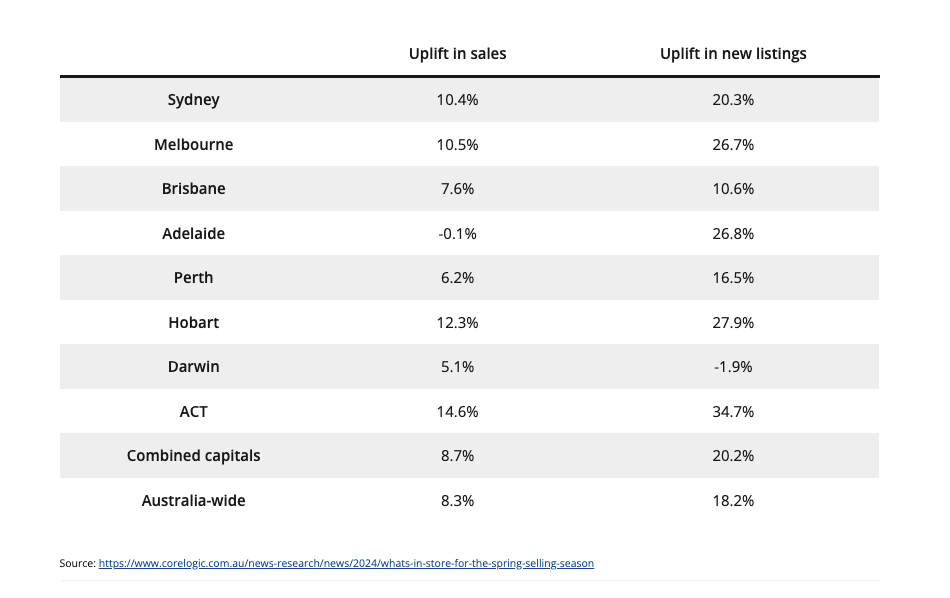
    According to CoreLogic, the average uplift in new listings between winter and spring has been 18.2% over the past decade. Meanwhile, the average uplift in sales has been 8.3%.

    As the table below shows, Australia’s southern capitals appear to have the highest increase in springtime listings.

    Keep in mind that in some cities, sales volumes have actually decreased during past spring seasons due to market conditions. Examples include Sydney and Melbourne in the spring of 2015, 2017 and 2018, when temporary macroprudential rules caused investor demand to plummet.

    This spring, high interest rates, slowing economic conditions and reduced consumer sentiment could affect demand. There’s also a fair bit of uncertainty in the air about the cost of living and inflation, which could keep the traditionally busy spring selling season a bit more subdued in 2024.

    Varied selling conditions from region to region

    Supply and demand across Australia’s capitals is pretty varied at the moment, which means some areas may perform better than others this spring.

    In Melbourne, for example, there were 5,400 more new listings added to the market in the past three months than sales taking place. If you’re looking to buy in Victoria’s capital this spring, conditions may favour you.

    Adelaide and Perth, on the other hand, saw sales outpace the number of new listings added. In these markets, sellers may have the upper hand this spring. This may also be the case in some of the more affordable markets of Brisbane such as Beaudesert, according to CoreLogic.

    If you’re a prospective buyer, make sure you do plenty of research to see how the local market has been performing, so that you’re able to make an informed bid or offer.

    Interest rates will likely stay the same

    At its last meeting, the Reserve Bank of Australia (RBA) spared Aussie borrowers a cash rate rise. However, RBA governor Michele Bullock warned a rate cut was ‘not on the agenda’ in the near term. Most people expect we won’t see a cash rate cut until 2025.

    The cash rate is currently sitting at 4.35% and the average home loan interest rate is 6.28% p.a. (owner occupier). Interestingly, 98.2% of new home loans are variable, while only 1.8% are fixed. It seems buyers are hedging their bets, in case the RBA does decide to cut the cash rate.

    Keep in mind that if the RBA lowers the cash rate, property prices may well rise again in line with greater demand. For some buyers, it may be worth getting into the market sooner rather than waiting for a cash rate cut.

    Ready to explore your finance options?

    While many buyers are adopting a ‘wait and see’ attitude, it’s important to have your finance in order in case you do come across your dream property.

    Talk to us about getting pre-approved and be ready to purchase when the right property comes along. Get in touch today.

  • Questions To Ask During An Inspection

    When you’ve been scrolling through marketing photos of a property and you finally set foot in it at an inspection, it can be easy to get swept up in the moment.

    Home stylists can be very clever at making you fall in love with a property. It’s their job to help you imagine yourself living there, or to imagine your ideal tenants in the property.

    However, before you pounce on that dream slice of real estate you’ve been eyeing off, here are some key questions to ask yourself.

    Are clever staging tactics trying to hide anything?

    Most properties are staged to sell nowadays, as vendors know they can often get top dollar for houses and units that are beautifully presented at inspection. Try to look past the cosmetics for faults and defects that could prove costly to repair later.

    Is a rug cleverly disguising uneven floors? Is a pot plant hiding cracks in a wall?

    Has wide-angle photography made the living room or bedrooms look bigger in the marketing photos than they actually are?

    Is the lighting covering up the fact that the property feels more like a cave?

    Remember, the contemporary furniture, art and décor won’t be staying once the property is yours, so don’t fall for those kinds of distractions.

    What renovations or modifications have been done?

    It’s always smart to ask about any previous renovations. This can give you a clearer picture of the property’s true value, and who knows, it might spark ideas for your own future projects. Plus, if you’re thinking of making changes later on, asking about past work can help reveal any council restrictions or subdivision limitations that could impact your plans.

    Why are they selling, and what price are they hoping for?

    Asking why the owners are selling—and how long the property has been on the market for—can give you valuable insight, especially if they’re in a rush to sell. This, paired with finding out the price they’re expecting, can help you assess if the property fits your budget and gives you the upper hand in negotiations. The more you know, the better you can shape your offer.

    What’s happening up top?

    A leaky roof or water damage can be costly to fix. Signs there could be a problem include mould on the roof, roof rot, missing or buckling tiles, damaged flashing, wavy cornices, and damp patches on ceilings or walls.

    Have a good look at the roof from outside the property. Check the roof gutters for rust, and make sure the downpipes run to the storm water drains.

    Inside, assess the ceilings for sagging. An easy tip is to shine a torch across the ceilings, which should show up any deflections and defects.

    Again, get a professional building inspection to be on the safe side.

    What’s the plumbing like?

    Don’t be afraid to turn on the taps and flush the toilets during the open inspection. You’ll want to listen for hammer issues and check the hot water is working.

    Also, ask how old the hot water system is and when it was last serviced.

    What’s the property’s orientation?

    Orientation is really important because it affects how much natural light the property will get at different times of the year. North or northeast facing properties often get the most sunlight.

    If the ceiling lights are ablaze during the inspection and it’s a sunny day, the house may lack natural light and you may be in for a pretty dark winter.

    Have you done enough preliminary research?

    You should always do some digging to understand more about the suburb before buying.

    How is the area performing? What is the capital growth like?

    How are comparative sales tracking and is the listed price fair?

    What’s the lifestyle offering like nearby and is there access to amenities? Are there any planned developments or zoning changes that could impact your purchase?

    Ready for a spring purchase?

    We’d love to line up the finance you need to get into your own home or to buy an investment property this spring.

    Chat to us and we’ll get the ball rolling with pre-approval today.